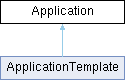
#include <application.hpp>
Definition at line 11 of file application.hpp.
◆ Application()
| Application::Application |
( |
const char * | window_name, |
|
|
unsigned int | width, |
|
|
unsigned int | height, |
|
|
unsigned int | fullscreen_width, |
|
|
unsigned int | fullscreen_height, |
|
|
bool | resizable = false, |
|
|
bool | imgui = true ) |
◆ ~Application()
| Application::~Application |
( |
| ) |
|
◆ OnImGuiRender()
| void Application::OnImGuiRender |
( |
| ) |
|
|
virtual |
◆ OnImGuiUpdate()
| void Application::OnImGuiUpdate |
( |
| ) |
|
|
virtual |
◆ OnRender()
| void Application::OnRender |
( |
| ) |
|
|
virtual |
◆ OnUpdate()
| void Application::OnUpdate |
( |
const double | frame_time | ) |
|
|
virtual |
This function is called every m_FixedTimeStep seconds. It's independent from the framerate. Edit m_FixedTimeStep to change the time between two calls.
- Parameters
-
| frame_time | the current frame time, should be m_FixedTimeStep |
Reimplemented in ApplicationTemplate.
Definition at line 127 of file application.cpp.
◆ Run()
| void Application::Run |
( |
| ) |
|
◆ m_Accumulator
| float Application::m_Accumulator =0.0f |
|
protected |
◆ m_FixedTimeStep
| float Application::m_FixedTimeStep =1.0f/60.0f |
|
protected |
◆ m_ImGui
| bool Application::m_ImGui |
|
protected |
◆ m_Scene
| Scene* Application::m_Scene |
|
protected |
◆ m_WindowName
| const char* Application::m_WindowName |
|
protected |
The documentation for this class was generated from the following files: